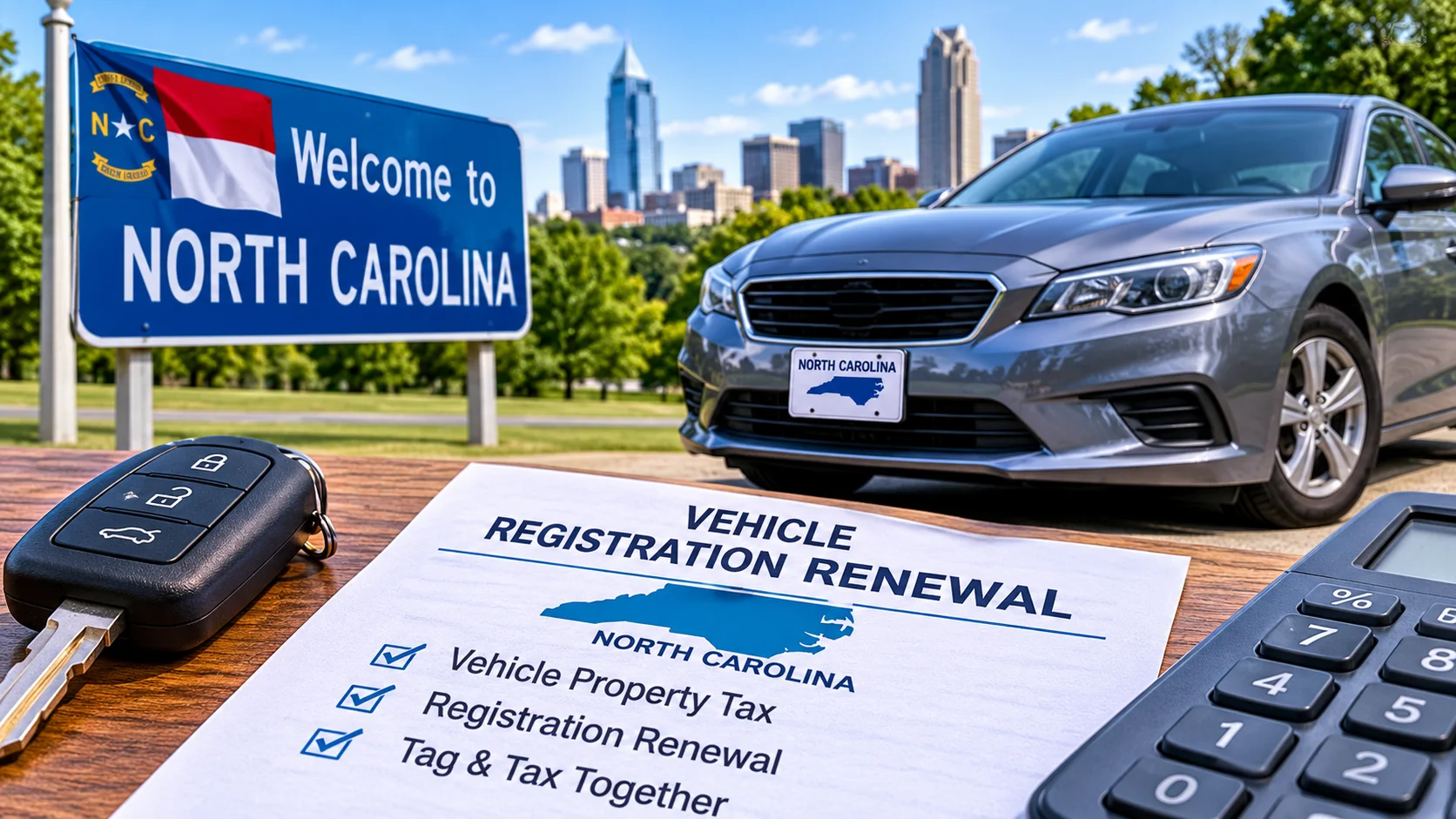
North Carolina vehicle owners generally pay their annual vehicle property tax at the same time they renew their vehicle registration. The state's Tag & Tax Together program combines the two charges into one notice and one payment.
The amount of vehicle property tax varies depending on the vehicle's appraised value and the applicable county, municipal and other local tax rates. Drivers can check their renewal notices, use the state's official tax estimator and contact their county tax assessor if they have questions about an assessment.
North Carolina also changed its vehicle registration process on October 1, 2026. Drivers no longer automatically receive a physical license plate sticker or printed registration card after completing a registration or renewal transaction.
Here is what North Carolina motorists need to know about vehicle property taxes, payment deadlines, registration renewals and valuation appeals.
What Is North Carolina Vehicle Property Tax?
Vehicle property tax is a local tax assessed on qualifying motor vehicles registered in North Carolina.
County tax assessors determine the taxable value of registered vehicles. The applicable local tax rates are then used to calculate the property tax owed.
North Carolina collects vehicle property tax through its Tag & Tax Together program. The system combines the annual vehicle registration renewal fee and vehicle property tax into one notice, allowing motorists to pay both charges together.
The North Carolina Division of Motor Vehicles (NCDMV) collects the combined payment and distributes the appropriate tax revenue to local governments.
The program applies to vehicle property taxes, not homeowners' real estate taxes or property taxes paid through a mortgage.
Official information is available through the NCDMV Vehicle Property Taxes page and the North Carolina Department of Revenue's Tag & Tax Together program.
More Stories You May Like – NewsToToday
https://newstotoday.com/environment-climate/weekend-rain-possible-central-north-carolina-dry-stretch
How Is Vehicle Property Tax Calculated in North Carolina?
North Carolina does not charge every vehicle owner the same property tax amount. The final bill depends on several factors.
These generally include:
Vehicle value: The county assessor determines the vehicle's taxable value under North Carolina valuation rules.
County tax rate: The county rate applies to the vehicle's relevant taxing location.
Municipal tax rate: An additional municipal rate may apply if the vehicle is located within a city or town that levies property taxes.
Additional local vehicle taxes: Certain taxing units may impose additional motor vehicle taxes.
Proration: Some new registrations are subject to prorated taxes based on the applicable registration date and remaining tax period.
Under North Carolina law, assessors use the applicable taxing-unit rates and vehicle valuation rules when preparing the combined tax and registration notice.
The notice identifies the appraised vehicle value and the tax rate for each applicable taxing unit.
North Carolina Vehicle Property Tax Calculation Formula
A simplified formula for understanding a full-year vehicle property tax calculation is:
Vehicle property tax = (Appraised vehicle value ÷ 100) × Applicable combined tax rate
For example, consider a vehicle with an appraised value of $20,000 and an illustrative combined tax rate of $0.70 per $100 of value.
Vehicle appraised value: $20,000
Value divided by 100: 200
Illustrative combined tax rate: $0.70
Estimated property tax: 200 × $0.70 = $140
Illustrative annual property tax: $140
This is an educational example, not an actual North Carolina county tax rate or a guaranteed bill.
Actual vehicle property taxes can differ because local rates and additional vehicle taxes vary. North Carolina law also provides for proration when qualifying new registrations are issued.
The registration renewal fee is a separate charge, even though it appears on the same combined notice.
For the legal requirements, see North Carolina General Statutes, Article 22A.
How to Look Up or Estimate North Carolina Vehicle Property Tax
North Carolina motorists can use the official NCDMV vehicle property tax estimator to get an approximate idea of their potential tax bill.
The estimator is designed to help vehicle owners understand what they might owe. It should not be treated as the final tax amount.
To check an estimate:
Visit the NCDMV Vehicle Property Tax Estimator.
Enter the requested vehicle information.
Provide the applicable location or county information.
Review the estimated property tax.
The final bill may differ from the estimate because the county assessor determines the vehicle's actual taxable value and applicable local rates and charges.
For the most accurate amount, check the combined Tag & Tax notice issued for your vehicle or contact the county tax assessor.
How to Pay North Carolina Vehicle Property Tax
Vehicle property tax is generally paid together with the annual registration renewal fee through NCDMV.
North Carolina offers several payment methods.
1. Pay Online
Vehicle owners can use NCDMV's online registration renewal service to pay their combined registration and property tax charges.
Visit the official NCDMV Registration Renewal page and follow the online instructions.
Have your vehicle and registration information available before starting the renewal process.
2. Pay by Mail
Motorists can mail their payment using the instructions and address provided on their registration renewal notice.
Review the notice carefully to confirm the payment amount and mailing details. Allow sufficient time for the payment to reach NCDMV before the applicable deadline.
3. Pay in Person
Vehicle owners can also renew their registrations and make payments at an NCDMV license plate agency.
Use the official NCDMV license plate agency locator to find a location.
Important: Vehicle property tax payments are generally made through NCDMV, not directly at the county tax office. County assessors handle questions about vehicle valuations, applicable local tax rates and assessment appeals.
When Is North Carolina Vehicle Property Tax Due?
Vehicle property tax is generally due with the annual vehicle registration renewal.
The combined Tag & Tax notice provides the amount owed and the payment deadline. NCDMV says motorists generally receive the notice approximately 60 days before their registration expires.
The exact legal due date can depend on the registration system and circumstances. North Carolina General Statutes §105-330.4 sets out the due-date rules for registered vehicles.
Drivers should review their renewal notices as soon as they arrive rather than waiting until the registration expires.
This gives motorists time to complete any required inspection, check their vehicle information and arrange payment.
Vehicle Inspection Before Registration Renewal
Most vehicles must pass the applicable North Carolina inspection requirements before their registrations can be renewed.
NCDMV allows motorists to complete the required inspection up to 90 days before their registration renewal date.
North Carolina's inspection requirements include:
A safety inspection for vehicles subject to the requirement.
An emissions inspection for vehicles registered in 19 designated counties.
An inspection exemption for vehicles that qualify under the state's age-related rules, including vehicles 35 years old or older.
Inspection fees are paid separately to the inspection station. They are not included in the vehicle property tax payment.
Motorists should check the NCDMV registration renewal instructions and NCDOR vehicle property tax FAQs for applicable requirements.
North Carolina Vehicle Registration Changes Effective October 1, 2026
North Carolina changed how vehicle owners receive their registration documents beginning October 1, 2026.
Under the updated process, NCDMV no longer automatically issues a physical license plate sticker or a printed registration card after a registration or renewal transaction.
Instead, vehicle owners can access their digital registration online and download or print a copy if needed.
The change does not eliminate the requirement to renew vehicle registrations or pay vehicle property taxes.
Drivers must still:
Renew their vehicle registrations annually.
Pay applicable registration fees and vehicle property taxes.
Maintain continuous vehicle insurance coverage.
Complete required vehicle inspections.
Law enforcement can verify registration status electronically.
Motorists who prefer a paper copy can download and print the free registration document. NCDMV also provides options to obtain a printed copy through a license plate agency or by mail for a fee.
More information is available through the official NCDMV Digital Vehicle Registration page.
New Vehicle Purchases and New North Carolina Residents
People who have recently purchased a vehicle or moved to North Carolina may have a different initial registration and tax process.
Eligible customers registering a newly purchased vehicle or registering a vehicle after moving to North Carolina may defer vehicle property tax payment for 60 days by obtaining a limited registration plate.
This is a payment deferral, not a permanent tax exemption.
For a newly purchased vehicle, NCDMV says the other required title and registration charges must be paid when the vehicle is titled and registered. The vehicle property tax must then be paid within 60 days.
The limited registration plate expires after 60 days, and NCDMV says there is no additional grace period for paying the property tax.
New residents and vehicle buyers should review the applicable requirements before relying on this option.
Visit the NCDMV Vehicle Property Taxes page for official information.
What Happens If You Pay Vehicle Property Tax Late?
Failing to pay vehicle property tax and registration renewal charges by the applicable deadline can result in additional costs.
According to NCDMV, interest on late vehicle property tax and registration payments accrues at the following rates:
A 5% interest charge applies for the remainder of the month following the date the registration expires, under the NCDMV's published guidance.
Beginning in the second month following the due date, interest accrues at 0.75% per month until the taxes and fees are paid.
North Carolina law also specifies the applicable tax due dates and interest rules. Motorists should use the due date on their official notice when checking their payment obligations.
Registration Renewal Late Fee
NCDMV also charges a registration renewal late fee of up to $25 when a renewal payment is made after the license plate's expiration date.
The registration late fee is separate from property tax interest.
NCDMV's renewal guidance says motorists may legally operate their vehicles for up to 15 days after the registration's expiration date, but the late fee can still apply to a renewal paid after expiration.
Drivers should not rely on this period as an extension of their payment deadline. They should renew their registrations and pay their vehicle taxes on time.
See the NCDMV registration renewal and late fee guidance and North Carolina General Statutes §105-330.4.
How to Appeal a North Carolina Vehicle Property Tax Assessment
Vehicle owners who believe their vehicle has been assigned an incorrect taxable value can appeal the assessment through the county tax assessor.
For example, an owner may want to question an assessment if the vehicle's recorded information, mileage or condition appears to have been incorrectly considered.
The county assessor, rather than NCDMV, handles vehicle property tax valuation questions and appeals.
What Is the Vehicle Property Tax Appeal Deadline?
Under North Carolina General Statutes §105-330.2, a vehicle owner may appeal the appraised value by filing a written request with the county assessor within 30 days of the date the vehicle taxes are due.
An owner who appeals the vehicle's appraised value must still pay the tax when it is due.
If the appeal is decided in the owner's favor, the owner may receive a full or partial refund.
Motorists should read their combined tax and registration notice and contact their county assessor promptly if they disagree with the assessment.
Read North Carolina General Statutes §105-330.2.
Why Does Vehicle Property Tax Differ by County in North Carolina?
Two North Carolina residents who own similar vehicles may receive different property tax bills because their vehicles may be subject to different local tax rates.
North Carolina counties and municipalities establish local property tax rates. The applicable rates depend on the vehicle's taxing location.
For example, a vehicle located within a municipality may be subject to a different combined tax rate than a similar vehicle located in an unincorporated part of the same county.
Some taxing jurisdictions may also impose additional motor vehicle taxes.
This is why motorists should not rely on a single statewide rate or assume that a neighbor's vehicle tax bill will be the same as theirs.
The North Carolina Department of Revenue publishes annual county and municipal property tax rate information.
Residents can consult the 2026–2027 North Carolina County and Municipal Property Tax Rates and contact their county tax assessor for vehicle-specific questions.
What If You Have Not Registered or Renewed Your Vehicle?
North Carolina residents who have not registered their vehicles or have not renewed their registrations are required to list their vehicles with their county of residence by January 31 each year.
This requirement is particularly important for people who keep an unregistered vehicle or allow a registration to expire without renewing it.
The vehicle owner should contact the county tax assessor for instructions on listing an unregistered vehicle and determining any applicable tax obligations.
More information is available in North Carolina General Statutes §105-330.3.
Frequently Asked Questions About North Carolina Vehicle Property Tax
Can I renew my North Carolina vehicle registration without paying property tax?
Generally, no. Under the Tag & Tax Together program, vehicle property tax and registration renewal charges must be paid together. Eligible new vehicle purchasers and new North Carolina residents may use the limited registration plate deferral process.
Can I pay North Carolina vehicle property tax directly to my county?
No. Registered vehicle property tax payments are generally made through NCDMV as part of the combined registration renewal process. County tax assessors handle questions about vehicle valuations, tax rates and assessment appeals.
How often do North Carolina vehicle owners pay property tax?
Most registered vehicles are subject to annual vehicle property tax. The tax is generally collected with the vehicle's annual registration renewal.
Does North Carolina vehicle property tax include my home property tax?
No. Tag & Tax Together applies to vehicle property taxes. It does not include real estate taxes on a home or property taxes paid through a mortgage escrow account.
What should I do if I do not receive my vehicle tax and registration notice?
Check your mailing address with NCDMV. If you moved and did not update your address, your renewal notice may not reach you.
You can also check your registration information through NCDMV's online services or contact the agency for renewal assistance.
What happens if I move to another county in North Carolina?
A move may affect the applicable vehicle tax location and assessment.
Update your address with NCDMV. If you have moved since your last renewal, NCDMV advises motorists not to mail the old renewal and payment. Visit a license plate agency to obtain a corrected registration and tax amount.
Can I dispute the value assigned to my vehicle?
Yes. Vehicle owners can appeal the appraised value through their county tax assessor.
The statutory deadline is generally 30 days from the date vehicle taxes are due. The tax must still be paid when due, subject to a possible refund if the appeal is successful.
Is the NCDMV vehicle property tax calculator accurate?
The official estimator can provide a useful estimate, but it is not a final tax bill. The actual amount is determined using the vehicle's assessed value and applicable local rates and charges.
Do I have to pay vehicle property tax when I buy a new car?
Vehicle property tax may be due when a new vehicle is registered. Eligible buyers can defer payment for 60 days by obtaining a limited registration plate, subject to NCDMV requirements.
Do North Carolina drivers still receive physical registration stickers?
No. Beginning October 1, 2026, NCDMV stopped automatically issuing physical license plate stickers and printed registration cards. Drivers can access their digital registration and print a copy if needed.
Are vehicles 35 years old or older exempt from North Carolina inspections?
NCDOR's vehicle tax FAQ identifies vehicles 35 years old or older as exempt from inspection. Owners should check the current NCDMV requirements for their particular vehicle and registration.
Where to Get Official Help
Vehicle owners should contact the appropriate government office depending on their question.
Registration renewal and payment: North Carolina Division of Motor Vehicles
Vehicle valuation and assessment appeals: Tax assessor in the county where the vehicle is registered.
Statewide property tax information: North Carolina Department of Revenue
Vehicle property tax estimation: NCDMV Vehicle Property Tax Estimator
Vehicle registration documents: NCDMV Digital Vehicle Registration
Vehicle valuation appeal law: North Carolina General Statutes §105-330.2
Final Takeaway
North Carolina's Tag & Tax Together program allows most vehicle owners to pay their annual registration renewal fee and vehicle property tax in one payment.
The actual tax amount depends on the vehicle's appraised value and the local tax rates and charges that apply to it. Motorists should review their renewal notices, complete required inspections, pay by the stated deadline and contact their county assessor if they disagree with their vehicle's assessed value.
Drivers should also remember that North Carolina's digital vehicle registration changes took effect on October 1, 2026. Although physical stickers and automatically printed registration cards are no longer issued, annual registration renewals and vehicle property tax payments remain required.
Checking official NCDMV and NCDOR information before making a payment can help motorists avoid confusion and unexpected late charges.
Editorial note: Tax rates, fees, inspection rules and registration procedures can change. Readers should confirm current requirements with NCDMV and their county tax assessor before making payment or filing an appeal.


